松本良多 インタビュー | クリエイティブペーパー - 2016-2020
>100 Views
November 27, 23
スライド概要
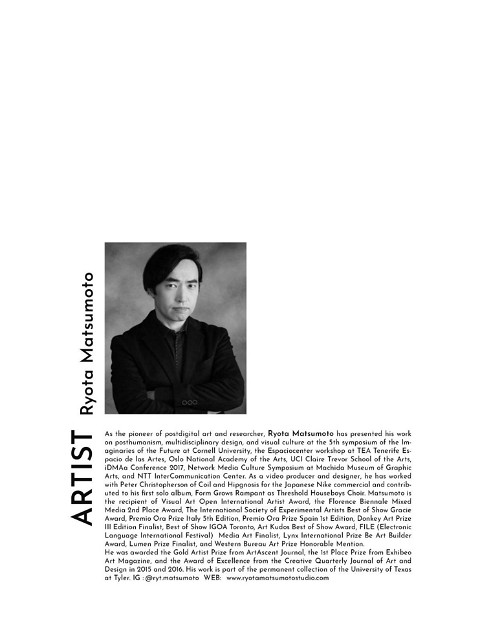
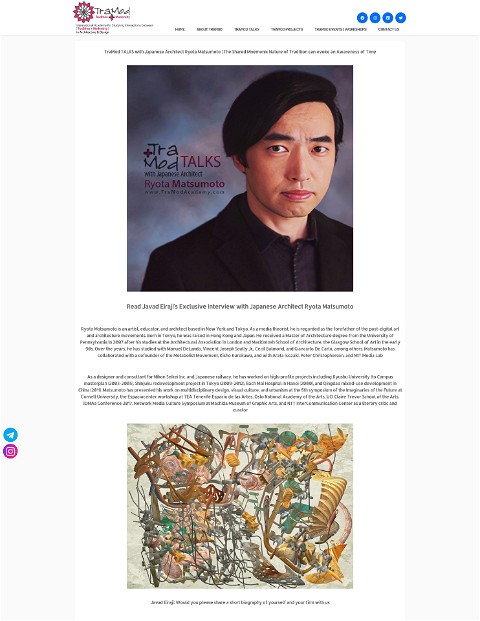
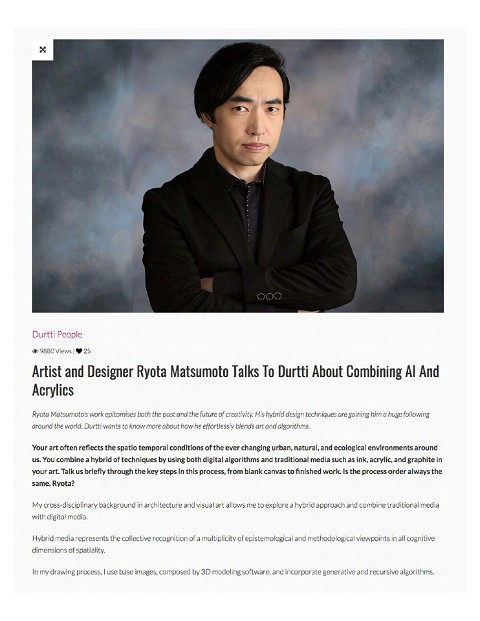
松本良多は東京出身のニューヨークを拠点として活動するアーティスト、建築デザイナー、アーバンプランナー、教育者。
10代を香港とマンハッタンで過ごした後、ロンドンのAAスクール、グラスゴー美術大学、マイアミ大学にて建築と哲学を学び、2007年ペンシルベニア大学大学院芸術学部建築学科を首席で卒業する。マニュエル・デランダ、ヴィンセント・ジョゼフ・スカーリー、セシル・バルモンド、 ジャンカルロ・デ・カルロに師事する。
90年代よりMITメディアラボ、磯崎新、黒川紀章、インダストリアル・ミュージックの先駆者、ピーター・クリストファーソンと協働し、ベトナムバクマイ病院、九州大学センター地区のマスタープランをはじめ多数の建築、都市計画、アートのプロジェクトを手掛ける。ポーランドのシレジア大学の講師を経て、2016年よりプリマス大学 Transart Instituteの客員教授に就任、クーパー・ユニオン、プラット・インスティテュート、コーネル大学、ニューセンター・オブ・リサーチ・アンド・プラクティス シアトル校にてゲストレクチャラーとして教鞭をとっている。シカゴ市文化庁客員キュレーター、英国美術協会 (British Art Network) 名誉会員。
オスロ国立美術大学、カリフォルニア大学アーバイン校、テネリフェ市立美術館にて加速主義、ポストヒューマニズムについて講演している。2017年にはレバーヒューム・トラスト国際学会の招聘によりコーネル大学にて「ポストヒューマニズムと未来都市」について講演する。2019年にはロンドンICAにて「トランスヒューマン社会と生成の唯物論」のレクチャーをキュレート、2020年以降はロージ・ブライドッティとのクリティカル・ヒューマニズムについての講義、エドワード・カックとのカリフォルニア大学アーバイン校でのワークショップと多岐な分野で活動している。
ハイブリッド・アートとアルゴリズミック・コンピュテーションの手法を応用したメディア・アートの作品のインターナショナルな評価によりFILE(Electronic Language International Festival)Prix Lux Finalist、英国 Visual Art Open International Artist Awardを受賞する。
2016年には日本人として初めてイタリアとスペインからPremio Ora賞を同時に受けて2015年、2016年、2017年にロサンゼルスのLos Angeles Center for Digital Art、BYTE Gallery トランスベニア大学、ArtSpace ペスカラにて個展を開催する。2018年、韓国国立中央博物館の招聘展、テキサス大学、 ロサンゼルス現代美術館の常設展示作品のアーティストに選ばれている。

関連スライド

各ページのテキスト
CreativPaper DIRECTORY MAGAZINE SHOP INFO Conversation with Ryota Matsumoto INTERVIEW Our ever-expanding population is placing incomprehensible demands on the one place in the universe that we call home. Resources and habitats are being strained to their limits. Forest fires, plastic pollution, species extinction and shortages of food and potable water are current problems. As an artist, lecturer and urban planner, Tokyo based Ryota Matsumoto recently had a conversation with us about the demands placed on urban landscapes and how it needs to evolve with the times. Ryota was raised in Hong Kong and Japan and received a Master of Architecture degree from the University of Pennsylvania in 2007. He has also collaborated with the cofounder of the Metabolist Movement, Kisho Kurokawa. As an urban planner, what are your thoughts on the evolution of the urban landscape to keep up with the increasing demands placed on it? The urban patterns and processes are intricate, non-linear systems that are comprised of a metastable assemblage of interacting components including ecological, sociocultural, climatic, and economic relations. The whole ecosphere reveals the extensive biomorphic entity across multiple levels of granularity and abstraction. We need to embrace a holistic and integrated approach that links sustainable ecology to urban planning and management. The integration of a theoretical framework to structure all aspects of research outcomes, including complexity, resilience, socio-ecological systems, eco-psychoanalysis, smart grid computing and sustainability science, is crucial for developing the sustainable urban environment. Would you say that your pieces are three-dimensional dialogues on the structure of our modern world? Yes, I think so. Our sociocultural constructs focus on daily practice and the embodied experience of places of social memory. This is observed and reflected in my work to recreate states of intensity along the spectrum of the collective effect between the human body, the nonhuman agents, the urban artefacts and all the infinitesimal steps in between as visual schemas. Consequently, the transduction process of these intensities as a time-image is transcribed in the artwork as a hybrid interface between the necessary actual and the possibilist virtual within a spatiotemporal continuum.
Is it true that you spent some time growing up in Hong Kong? Did that time influence you artistically? I was fortunate enough to experience firsthand Hong Kong's rapid urbanization, which was driven by economic growth throughout the 70s and early 80s. I was fascinated by the fact that both the Kowloon Walled City and the Shanghai Bank Building stood only a few miles apart from each other at around the same time. It dawned on me that the juxtaposition and coexistence of binary polar opposite elements in cities denote both coherent and incongruous imagery in a disjunctive and somewhat intriguing way, regardless of their function and nature. That seemingly contradicted notion and dual perspective, which also gripped the streets of Hong Kong, certainly influenced my perception of urbanism in the early days. How does your creative process begin? There are always both analogue and digital processes involved in my work, and sometimes I incorporate both concurrently. I assemble unrelated images generated by algorithms with different parameters and create a metaphoric or disjunctive association from them. On other occasions, I simply start by combining random hand-drawn sketches that I have accumulated over the years and merge them into a unified or paradoxical entity. How do you find a balance between aesthetics and meaning in your work? We could attest that aesthetics represent one's critical reflection on the range of affective intensities that are immanent in sociocultural entities. As a field, aesthetics is said to be defined as a complex interaction between sensory faculties and meaning-making experiences in cognitive processes. This leads to my understanding that the aesthetic experience essentially integrates cognitive sensations with the meaning-making process in the semiotic context, and both aspects are crucial for experiencing art objects. Consequently, I believe art explores how visual representation is translated into meaning, but also how the flux of visual narratives evokes a sensory effect simultaneously.
Japan, and particularly Tokyo, is seen as a benchmark on how to balance the demands of contemporary society and space, what are your thoughts on that? Tokyo is an urban space that is an antipode to the orderly configuration of contemporary European gridded city planning, which has clearly defined certain precepts to prescribe the patterns based on underlying infrastructures. The schema of the Japanese city can be decoded through its organic development around the multicellular nature of voids in tandem with their topographic landscape. Consequently, the centripetal structure of the traditional urban space is displaced in favour of the centrifugal multiplication of specialized assemblages. Both spatial structures of Tokyo and the society's collective memory are said to be built around emptiness or verdant vacuity, as Roland Barthes pointed out in Empires of Sign. The spatio-temporal understanding of the Japanese city reflects the amorphous and transcendental nature of urban living of cognitive capitalist society, devoid of coherent interplay both among its inhabitants and across the urban milieu. Could you talk us through your experience of exhibiting at Folkstone, England? The artwork, Still from Cities of Inextricable Velocities, was projected on the gallery wall throughout the exhibition period at Folkstone. The projected image was comprised of three phases of shifted layers and customized projectors with motorized bracket lifts were conceived to achieve the moiré effect. The preprogrammed cluster-oriented genetic algorithm optimized the subtle movement of each projector to attain the ever-evolving ethereal image. The outcome was the visual equivalent of Alvin Lucier's hypnotic work, Crossings that affect the specific neuroanatomical correlates of a viewer's sensory experience. What have you been working on at the moment? I am currently working on several collaborative projects, as well as group exhibitions. ryotamatsumoto.com MEDIA PARTNERS ART PARIS ART FAIR LA ART SHOW ART DUBAI 25-28.3.2020
INTERVIEW /RYOTA MATSUMOTO For better or for worse, as a species, we have had the most impact on the landscape of our planet. Observable from space, we have altered the face of our planet, illuminating and moulding it to meet our needs. Artist Ryota Matsumoto's work explores these relationships and changes, taking the form of visual commentaries of our dynamic landscape. Would you say that every aspect of our lives is influenced by art in one way or another? Yes, We are able to draw something rather banal, and it manages to speak a lot by itself. A simple object could be infused with a lot of anecdotes and memories with just brushes and a canvas. It proves the point that we are always inspired and influenced by every aspect of our lives and even ordinary matters that surround us and vice versa. Do you think we could ever curtail our negative impact on the planet since the beginning of the Anthropocene? First thing first, we need to look at the Anthropocene from a broader geological perspective rather than human-centric or academic one. We also need to be aware of the urgent proximity of nonhuman presences. The other crucial point is how much we could let the public to be aware of this grave situation that we are hopelessly mired in. 22
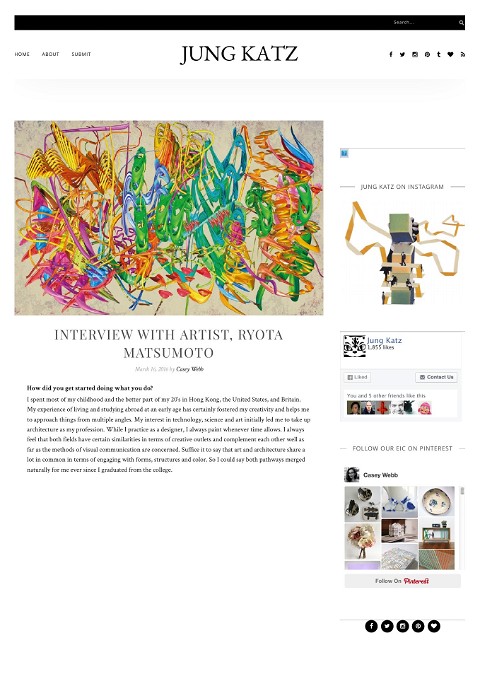
Above: Surviving in the Multidimensional Space of Cognitive Dissonace. 23
That would lead to set up effective grassroots organisations for coming face to face with the Anthropocene epoch as well as addressing the myriad of related environmental issues. In a nutshell, I believe that kind of shift in our outlook might eventually lead to curtailing our negative impact on the planet. What are you trying to communicate through your work as an artist? My work reflects the morphological transformations of our manifold ecological milieus that are attributed to a multitude of spatiotemporal phenomena influenced by sociocultural and urban built environments. They are created as visual commentaries on speculative changes in notions of societies, cultures and ecosystems in the transient nature of shifting and adaptive topography and geology. Do you think the lines between various disciplines are blurring with each passing day? I'd say so for some disciplines such as art, science and architecture specifically. There are a lot of cross-disciplinary collaborations among them lately, and they certainly blur the boundaries among them. I'd say that art is the glue to hold together different disciplines as it is the best medium to inform creative thinking. As someone who uses multiple mediums, If you had to pick between digital and analogue techniques to create art, what would it be and why? I would embrace analogue technique for creating art wholeheartedly, as that is what I am familiar with long before the start of the digital revolution in both architecture and fine art in the first place. To be honest, I am weary of constant firmware updates of digital tools almost on a monthly basis. People often refer to Japan and Tokyo specifically as the future of cities around the world. Are there lessons learnt that we could all benefit from? That is mostly the weird myth primarily created by some notable science fiction films and novels in the west, I believe. Moreover, I speculate that strange blend of street signs in both English and Japanese in the centre of Tokyo 24
Above: Swirling Effects and Their Wayside Phenomena. 25
Above: The Indistinct Notion of an Object Trajectory. 26
probably conjure up the illusion of the future cities. As far as I can tell, I think most of the Japanese cities aren't that different from cities in the rest of the world. It actually hits home for me that how much NY projects the future of cities considerably more so than Japanese cities with all those mega skyscrapers and huge logistical systems in Manhattan. Could you tell us a bit more about your time growing up in Hong Kong? I used to live in Hong Kong from the mid-70s to late 80s. That was when Hong Kong went through the drastic transformation from a tiny seaport town to one of the most prosperous business cities of the world. It might have influenced me enormously in academic respect, as that experience led me to study both architecture and urbanism in hindsight. Has the past year had any specific highlights for you? I had received two first-place awards for the artworks from Visual Art Open in the UK and ISEA of the United States last year. Those are undoubtedly memorable events as an artist thus far. Does Ryota have a morning routine? I tend to be a night owl and hardly ever have time for a morning routine, to be honest. It'd be nice to practice. Tai Chi or go jogging in the morning for my well being, of course. That is only an ideal anyway. www.ryotamatsumoto.com 27
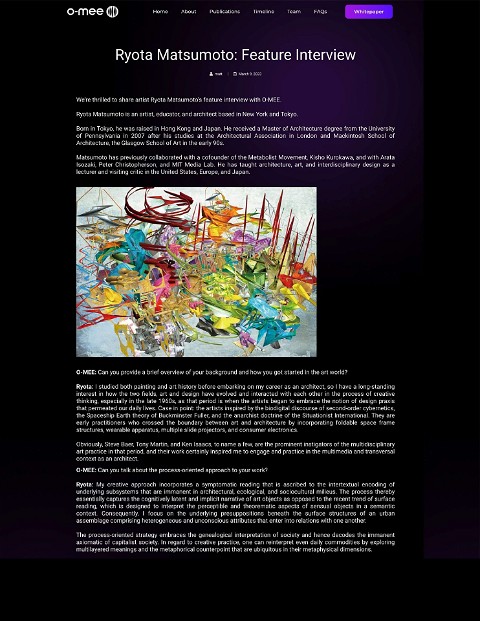
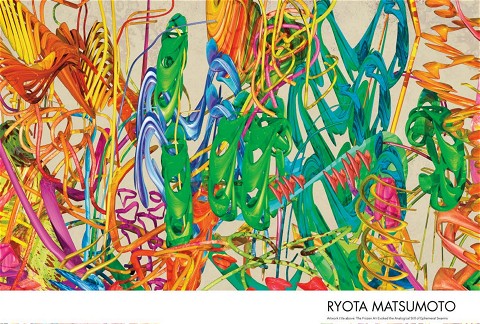
INTERVIEW /RYOTA MATSUMOTO Ryota Matsumoto's work reflects the morphological transformations of our ever-evolving urban and ecological milieus that are attributed to a multitude of spatiotemporal phenomena in influenced by social, economic and cultural factors. They are created as visual commentaries on speculative changes in notions of societies, cultures and ecosystems in the transient nature of constantly shi ing topography and geology. The artworks explore the hybrid technique combining both traditional media (ink, acrylic, and graphite) and digital media (algorithmic processing, parametric modelling, data transcoding and image compositing with custom software). The varying scale, a juxtaposition of biomorphic forms, intertwined textures, oblique projections and visual metamorphoses are employed as the multi-layered drawing methodologies to question and investigate the universal nature of urban meta-morphology, the eco-political reality of the Anthropocene epoch, the advancement of biomaterial technologies and their visual representation in the context of non-Euclidean configuration. Furthermore, the application of these techniques allows the work to transcend the boundaries between analogue and digital media as well as between two and multi-dimensional domains. www.ryotamatsumoto.com
The Indistinct Notion of an Object Trayectory.
High Frequency Captured on the Surface of Augmented Objects. Tell us a bit about Ryota Matsumoto Studio and the work it does? Ryota Matsumoto Studio is an interdisciplinary research laboratory that operates across the field of architecture, art and design. We adopted a synergistic approach to investigate a multitude of spatio-temporal phenomena of urban and ecological milieus at all scales. Currently, we are based in Tokyo, but there are correspondents in Berlin and New York to be engaged in a diversity of projects. As for now, we focus on developing a software that incorporate a recursive and reconfigurable algorithm based on multi-agent biological principals. It is capable of composing a hybrid image from the plethora of visual media driven by its own self-adaptive system. Some of my future media art are likely to reflect the outcome of this ongoing project.
The Chronology of Imaginary Scrolls. You also refer to yourself as an Urban Planner, Tell us a bit more about that and how that intertwines with your art? I've undertaken some of the major urban development projects in China, Vietnam and Tokyo over the course of my career as an urban planner. The experiences certainly inspire and motivate me to explore and question both ecological and ethical issues of the urban sustainable environment that have been influenced by the social and political realities of the Anthropocene epoch through my art, albeit with the use of visual semantics, analogies and metaphors. Your work comprises of complex layers and elements. How do you begin a painting and how long does each piece take on average? My drawing process involves base images that are composed by parametric and algorithmic design techniques.
Then they are merged and overlaid with traditional media such as acrylic, ink and graphite, as well as transcoded audio-visual data. These are further processed and looped through a series of arithmetic and stochastic operations by image editing programs and their custom plugins. The hybrid technique allows for a certain degree of unpredictability of visual dynamics. At the same time, painterly, organic sentiments of traditional media reveal themselves amidst the otherwise detached precision of digital drawings. Could you tell us a bit about the Metabolist movement and your involvement in it? I have collaborated with Kisho Kurokawa, who was the founder of Metabolist movement, on the campus master plan project in Fukuoka prefecture for several years in the late '90s. Prior to that, I've worked briefly with Isozaki Arata, another associate of the movement for the landscape design of the healthcare facilities in Tokyo. You spent a substantial time in London and Glasgow in the early 90's. Art certainly had its own identity and style then. How did that influence you as someone originating from Japan? My experience of living and studying in London and Glasgow in early '90s has certainly fostered my creativity and helps me to approach things from multiple angles. It was a few years before the digital tools and fabrications entered into the realm of architectural education. So greater emphasis was placed on theoretical discourses inspired by the work of continental thinkers and the discussions on those themes facilitated the exchange of ideas among students. Moreover we were trained to work as a bridging point among various disciplines and learned to pick things up quickly from different fields and apply them to resolve any issues in our design projects from early on. Consequently, interdisciplinary thinking comes naturally to me and I guess that kind of a critical thinking mindset is indispensable for the development of one's artistry.
Transient Field in the Air. If you could mention three benefits about being a Japanese artist what would they be? I can't really think of any off the top of my head. But suffice it to say that some people can't quite put the finger on what makes us tick as we aren't generally known to wear our hearts on our sleeves, thereby most people don't have much preconceived notions about what we would do. That enables us to explore creativity in our chosen field in depth and without much constraint. I don't know if this actually counts as a benefit though. A lot of individuals consider being an artist a difficult profession to sustain, especially when making a living is concerned. What are your thoughts on that? As a struggling artist and designer myself, I could only convince myself and accept the fact that the financial stability is not my priority and make the best of every moment in my creative life.