松本良多 インタビュー | ArtUp Mi 2023
101 Views
November 27, 23
スライド概要
松本良多は東京出身のニューヨークを拠点として活動するアーティスト、建築デザイナー、アーバンプランナー、教育者。
10代を香港とマンハッタンで過ごした後、ロンドンのAAスクール、グラスゴー美術大学、マイアミ大学にて建築と哲学を学び、2007年ペンシルベニア大学大学院芸術学部建築学科を首席で卒業する。マニュエル・デランダ、ヴィンセント・ジョゼフ・スカーリー、セシル・バルモンド、 ジャンカルロ・デ・カルロに師事する。
90年代よりMITメディアラボ、磯崎新、黒川紀章、インダストリアル・ミュージックの先駆者、ピーター・クリストファーソンと協働し、ベトナムバクマイ病院、九州大学センター地区のマスタープランをはじめ多数の建築、都市計画、アートのプロジェクトを手掛ける。ポーランドのシレジア大学の講師を経て、2016年よりプリマス大学 Transart Instituteの客員教授に就任、クーパー・ユニオン、プラット・インスティテュート、コーネル大学、ニューセンター・オブ・リサーチ・アンド・プラクティス シアトル校にてゲストレクチャラーとして教鞭をとっている。シカゴ市文化庁客員キュレーター、英国美術協会 (British Art Network) 名誉会員。
オスロ国立美術大学、カリフォルニア大学アーバイン校、テネリフェ市立美術館にて加速主義、ポストヒューマニズムについて講演している。2017年にはレバーヒューム・トラスト国際学会の招聘によりコーネル大学にて「ポストヒューマニズムと未来都市」について講演する。2019年にはロンドンICAにて「トランスヒューマン社会と生成の唯物論」のレクチャーをキュレート、2020年以降はロージ・ブライドッティとのクリティカル・ヒューマニズムについての講義、エドワード・カックとのカリフォルニア大学アーバイン校でのワークショップと多岐な分野で活動している。
ハイブリッド・アートとアルゴリズミック・コンピュテーションの手法を応用したメディア・アートの作品のインターナショナルな評価によりFILE(Electronic Language International Festival)Prix Lux Finalist、英国 Visual Art Open International Artist Awardを受賞する。
2016年には日本人として初めてイタリアとスペインからPremio Ora賞を同時に受けて2015年、2016年、2017年にロサンゼルスのLos Angeles Center for Digital Art、BYTE Gallery トランスベニア大学、ArtSpace ペスカラにて個展を開催する。2018年、韓国国立中央博物館の招聘展、テキサス大学、 ロサンゼルス現代美術館の常設展示作品のアーティストに選ばれている。

関連スライド

各ページのテキスト
ARTIST Ryota Matsumoto As the pioneer of postdigital art and researcher, Ryota Matsumoto has presented his work on posthumanism, multidisciplinary design, and visual culture at the 5th symposium of the Imaginaries of the Future at Cornell University, the Espaciocenter workshop at TEA Tenerife Espacio de las Artes, Oslo National Academy of the Arts, UCI Claire Trevor School of the Arts, iDMAa Conference 2017, Network Media Culture Symposium at Machida Museum of Graphic Arts, and NTT InterCommunication Center. As a video producer and designer, he has worked with Peter Christopherson of Coil and Hipgnosis for the Japanese Nike commercial and contributed to his first solo album, Form Grows Rampant as Threshold Houseboys Choir. Matsumoto is the recipient of Visual Art Open International Artist Award, the Florence Biennale Mixed Media 2nd Place Award, The International Society of Experimental Artists Best of Show Gracie Award, Premio Ora Prize Italy 5th Edition, Premio Ora Prize Spain 1st Edition, Donkey Art Prize III Edition Finalist, Best of Show IGOA Toronto, Art Kudos Best of Show Award, FILE (Electronic Language International Festival) Media Art Finalist, Lynx International Prize Be Art Builder Award, Lumen Prize Finalist, and Western Bureau Art Prize Honorable Mention. He was awarded the Gold Artist Prize from ArtAscent Journal, the 1st Place Prize from Exhibeo Art Magazine, and the Award of Excellence from the Creative Quarterly Journal of Art and Design in 2015 and 2016. His work is part of the permanent collection of the University of Texas at Tyler. IG : @ryt.matsumoto WEB: www.ryotamatsumotostudio.com
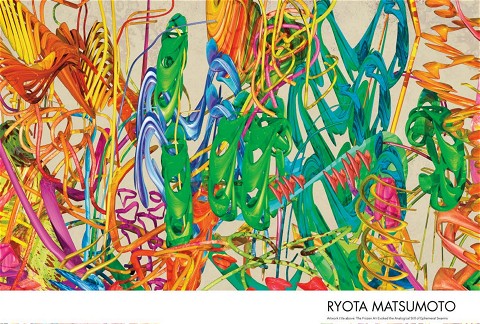
The Celestial Map of Dream Sequences, Mixed Media 23 - 32 in
Quantized Crackles of Emotional Scales, Mixed Media 24ix38 in
The High Overdrive and Its Undefinable Consequence, 31x47 in
AUM: What inspired you to be an artist? When did you begin expressing yourself through creative avenues? RM: I studied acrylic painting, lithography, and art history prior to embarking on my career as an architect and urban planner. Therefore, I am interested in how the fields of art and design have developed and influenced each other when it comes to the process of creative thinking. Specifically, I find the late 1960s to be a fascinating period, as that is when artists began to adopt the tenets of design praxis to their oeuvre, thus marking a pivotal moment in the intersection of these two domains. This is also around the period when Gilbert Simindon, André Leroi-Gourhan, and, to a certain degree, Claude Shannon began to recognize the intrinsically pharmacological nature of design technology that co-evolves with humanity. Hence, media theorists have begun to perceive technology as part of the epi-phylogenetic process. This concept also affirmed and accelerated the internalization of heteronomous artifactuality in one's development as an artist. Steve Baer, Tony Martin, and Ken Isaacs, to name a few, were the prominent instigators of the multidisciplinary art practice in that period, and their work certainly inspired me to engage and to practice in the multimedia and transversal context as an architect. Furthermore, my multicultural and cross-cultural experiences of growing up in Hong Kong, Tokyo, and London during my formative years helped me embrace a broader perspective on sociocultural intermediation and engagement with both artists and designers in creative practice. Both fields are inseparable and have complemented each other in my professional career since early on. AUM: Tell us about your artistic background: Are you self-taught or educated? Where did you receive your art education? Have you already graduated or you are studying? RM: I started out as an architect involved in urban planning and civic building design, even though I have an academic background in art history and lithography. After leaving the corporate firm where I was a senior architect, figuring out what I wanted to do took me almost a decade of uncertainty and reflection. Now, I am working as an academic and artist, teaching interdisciplinary design and visual arts. But, from time to time, I am still involved in some architectural projects. On reflection, my life is coming full circle at this moment in time.
AUM: What ideas are you currently exploring in your work? What themes fill you with performance anxiety? RM: Considering the progress of our collective individuation as social entities through technological advancement in the last 10 years or so, I believe that knowledge creation and its dissemination will continue to be shaped by a multivalent interplay of sociocultural and techno-pharmacological agents through our interaction with technical artifacts. This includes the way in which we create, share, and transmit knowledge across generations, as well as the underlying technologies that we use to facilitate the externalization of collective memory as tertiary retentions, as Bernard Stiegler stated in his first volume of Technics and Time. One area of interest for me is the impact of digital technologies on collective memory and the ways in which we construct narratives about the past. With the rise of social media and other participatory platforms, we are seeing a multiliteracies approach to engaging with historical memory that challenges traditional modes of archival practices and documentation. Rather than relying on a few authoritative sources to construct a historical narrative, people are able to share their personal stories and experiences with others, creating a rich tapestry of historical memory shaped by a diverse range of perspectives through participatory media. In short, everyone is able to contribute to the externalization of collective memory from the mnemonic capabilities of networked mediation. I am fascinated by the new modes of engaging with historical memory and how they pave the way for more inclusive and sustainable representations of sociocultural artifacts. Our understanding of the past is not only formulated by the content of historical narratives but also by the technological context in which they are presented as epi-phylogenetic constructs. AUM: Which mediums do you use in your work? Why do they attract you? RM: The process of visualizing ideas might evolve over time, but the medium is something I am less concerned about, be it analog, digital, architectural, or hybrid media. With my work, I explore the hybrid technique combining the algorithmic matrices of transition probabilities and photogrammetry. The varying scale, the juxtaposition of hybrid image-objects, mutually relatable geometrical references, intertwined projections, and visual metamorphoses are employed as layered drawing methodologies to question and decode the ubiquitous nature of urban meta-morphology in the virtual continuum, the inevitable corollaries of techno-economic disruption, and their disjunctive representation in the non-Euclidean manifolds of striated spatiality. My process-oriented compositional techniques imbue the artworks with what we see as the very essence of our socio-cultural environments, beyond the conventional protocols of architectural and artistic formalities. They conjure up the synthetic possibilities within which the spatial and temporal variations of existing spatial semiotics emerge as potential narratives of alchemical procedures. Herein may lie the extensively cross-referenced abstraction ushered in by hybrid media. AUM: What's next for you? Feel free to share any of your future plans such as exhibitions, travels, residencies, collaborations or any other interesting information relating to your art career. RM: There are some multidisciplinary projects involving electronic literature, and network culture underway in New York. We live in a great time where we can collaborate with artists online by exchanging files. This new paradigm brings together like-minded people in the art community, even if we live miles apart from one another. However, I am also enjoying the unpredictability of not knowing what I will do next in my life. AUM: Are you inspired by the works of your peers or anyone else in particular? RM: My knowledge of artists is limited, so I don't know if I actually get inspiration from fine art per se, and I am still learning about the contemporary field now. However, there are architects whom I admire for their meticulously detailed drawings: notably Takis Zenetos, Jan Kaplinsky, Peter Salter, Michael Webb, and visionary collectives from the '60s. Also, certain aspects of the work of Constant Nieuwenhuys always inspire me. His project New Babylon has several variations, and it evolves over time. He perceived the project as an ongoing project without any end date in sight and probably never actually completed it, at least as far as I know. His notion of architectural practice as the constant flux of becoming always inspires me. AUM: Tell us something that you like doing apart from making art. What funny things about yourself can you share with us? RM: As I mentioned in response to previous questions, I also practice as an architect and urban planner. The memorable project has to be the one that harks back to 2005. I was the senior associate at a Japanese corporate firm at that time and got the stroke of luck with Kisho Kurokawa on a university campus in Fukuoka prefecture, Japan. The initial master plan took us two years to complete, and we often had lunch together after meetings at his office in Aoyama. That was also around the time when he was preparing to run for Congress, so he was fixated on the idea of being a politician, and we often discussed how urban design can transform society. In hindsight, the project made me aware of a myriad of urban and ecological agendas that pertain to environmental ethics.
Still from Cities of Inextricable Velocities, Mixed Media 38 x 31 in
Recursive Topography of Uncertainty, Mixed Media, 31inx27in
Imaginary Echo Chamber, Mixed Media, 27inx32in
Swirling Effects and Their Wayside Phenomena, Mixed Media, 27inx28in
The Celestial Map of Dream Sequences, Mixed Media, 47inx35in,
The Extensity of Sferics Counterpoint, Mixed Media, 31inx45in