An Interview with Architect: Ryota Matsumoto - Art, Architecture, and Technology | Culture in Kent
118 Views
October 24, 23
スライド概要
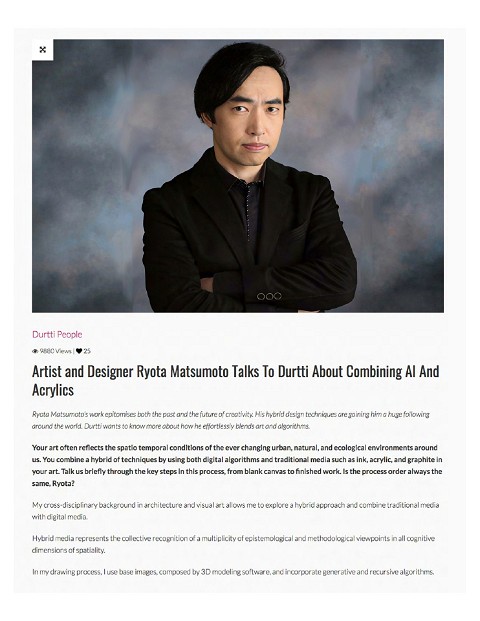
Ryota Matsumoto is an artist, educator, designer, cultural programmer, urban planner, and architect. As a media theorist, he is highly recognized as the iconic pioneer of the postdigital art.
He has collaborated with a cofounder of the Metabolist Movement, Kisho Kurokawa, and with Arata Isozaki, Peter Christopherson, and MIT Media Lab.
Matsumoto has presented his work on multidisciplinary design, visual culture, and urbanism to the 5th symposium of the Imaginaries of the Future at Cornell University, the Espaciocenter workshop at TEA Tenerife Espacio de las Artes, New Media Frontier Lecture Series at Oslo National Academy of the Arts, UCI Claire Trevor School of the Arts, iDMAa Conference 2017, Network Media Culture Symposium at CCA Kitakyushu, and NTT InterCommunication Center as a literary critic and media theorist. He curated the exhibition, Posthumanism, Epidigital, and Glitch Feminism at Machida City Museum of Graphic Arts in 2020.
As a composer, video producer and graphic designer, he has worked with Peter Christopherson of Coil and Throbbing Gristle for Japanese Nike commercial, his album, Form Grows Rampant, and early sessions of Amulet Edition.
His academic career started as a teaching assistant for Vincent Joseph Scully Jr. and his seminar, the Natural and Manmade in 1993. During his visiting fellowship at the Glasgow School of Art, he has been engaged in research on the process of integrated urban regeneration under the guidance of Giancarlo De Carlo and Isi Metzstein. He continued his pursuit in urban studies and participated in seminal research projects with MIT Media Lab and KieranTimberlake exploring high-rise modular housing, sustainability, and design interventions for Dhaka, Bangladesh in 2005.
Matsumoto has served as the MFA lecturer at Transart Institute, University of Plymouth. He works as a research associate and senior consultant for the New Centre of Research & Practice and the City of Dallas Office of Art and Culture respectively. Matsumoto is an honorary member of the British Art Network. He has been active as a guest critic on design reviews at Cornell University, Cooper Union, Columbia GSAPP, Rhode Island School of Design, and Pratt Institute.
Matsumoto is the recipient of Visual Art Open International Artist Award, Florence Biennale Mixed Media 2nd Place Award, The International Society of Experimental Artists Best of Show Award, Premio Ora Prize Italy 5th Edition, Premio Ora Prize Spain 1st Edition, Donkey Art Prize III Edition Finalist, Best of Show IGOA Toronto, Art Kudos Best of Show Award, FILE (Electronic Language International Festival) Media Art Finalist, Lynx International Prize Award, Lumen Prize Finalist, and Western Bureau Art Prize Honorable Mention.He was awarded the Gold Artist Prize from ArtAscent Journal, the 1st Place Prize from Exhibeo Art Magazine, and the Award of Excellence from the Creative Quarterly Journal of Art and Design in 2015 and 2016. His work is part of the permanent collection of the University of Texas at Tyler.
His work, writings, and interviews were published in Kalubrt Magazine, the University of North Carolina Wilmington Journal Palaver, Furtherfield.org, The Journal of Wild Culture, Studio Visit Magazine, Fresh Paint Magazine, H+ Magazine, International Artist Magazine, Made In Mind Magazine, Arizona State University Journal Superstition Review, Creative Review, Creative Boom, Next Nature Network, Rhizome.org, Monoskop, Carbon Culture Review, KooZA/rch, Supersonic Art, Post Digital Aesthetics (Berry and Dieter ed.), Drawing Discourse (University of North Carolina Asheville), Highlike (SEPI-SP editors), and Drawing Futures (The Bartlett UCL), among others.
Matsumoto’s multidisciplinary projects have been exhibited recently at Meadows Gallery University of Texas at Tyler, S. Tucker Cooke Gallery University of North Carolina Asheville, Sebastopol Center for the Arts, National Museum of Korea, CICA Museum, Van Der Plas Gallery, ArtHelix Gallery, Caelum Gallery, LAIR Gallery Lakehead University, Limner Gallery, the Cello Factory, University of the District of Columbia, Lux Art Gallery, Studio Montclair, Manifest Gallery, Center for Digital Narrative University of Bergen, Tenerife Espacio de las Artes, Art Basel Miami, ISEA International, FILE Sao Paulo, Nook Gallery, and Arts and Heritage Centre Altrincham. He had solo exhibitions at BYTE Gallery Transylvania University (2015), Los Angeles Center of Digital Art (2016), and Alviani ArtSpace, Pescara (2017).

関連スライド

各ページのテキスト
CULTURE IN KENT HOME HOME ALL PROFILES ALL EVENTS SEARCH ABOUT FEATURES CONTACT Ryota Matsumoto Website Ryota Matsumoto Twitter Facebook Instagram Linkedin Pinterest Share this page on: Ryota Matsumoto is an artist, educator, designer, cultural programmer, urban planner, and architect. As a media theorist, he is highly recognized as the iconic pioneer of the postdigital art. He has collaborated with a cofounder of the Metabolist Movement, Kisho Kurokawa, and with Arata Isozaki, Peter Christopherson, and MIT Media Lab. Ryota Matsumoto has presented his work on multidisciplinary design, visual culture, and urbanism to the 5th symposium of the Imaginaries of the Future at Cornell University, the Espaciocenter workshop at TEA Tenerife Espacio de las Artes, New Media Frontier Lecture Series at Oslo National Academy of the Arts, UCI Claire Trevor School of the Arts, IDMAa Conference 2017, Network Media Culture Symposium at CCA Kitakyushu, and NTT InterCommunication Center as a literary critic and media theorist. He curated the exhibition, Posthumanism, Epidigital, and Glitch Feminism at Machida City Museum of Graphic Arts in 2020. As a composer, video producer and graphic designer, he has worked with Peter Christopherson of Coil and Throbbing Gristle for Japanese Nike commercial, his album, Form Grows Rampant, and early sessions of Amulet Edition. His academic career started as a teaching assistant for Vincent Joseph Scully Jr. and his seminar, the Natural and Manmade in 1993. During his visiting fellowship at the Glasgow School of Art, he has been engaged in research on the process of integrated urban regeneration under the guidance of Giancarlo De Carlo and Isi Metzstein. He continued his pursuit in urban studies and participated in seminal research projects with MIT Media Lab and KieranTimberlake exploring high-rise modular housing, sustainability, and design interventions for Dhaka, Bangladesh in 2005. Ryota Matsumoto has served as the MFA lecturer at Transart Institute, University of Plymouth. He works as a research associate and senior consultant for the New Centre of Research & Practice and the City of Dallas Office of Art and Culture respectively. Matsumoto is an honorary member of the British Art Network. He has been active as a guest critic on design reviews at Cornell University, Cooper Union, Columbia GSAPP, Rhode Island School of Design, and Pratt Institute. Ryota Matsumoto is the recipient of Visual Art Open International Artist Award, Florence Biennale Mixed Media 2nd Place Award, The International Society of Experimental Artists Best of Show Award, Premio Ora Prize Italy 5th Edition, Premio Ora Prize Spain 1st Edition, Donkey Art Prize III Edition Finalist, Best of Show IGOA Toronto, Art Kudos Best of Show Award, FILE (Electronic Language International Festival) Media Art Finalist, Lynx International Prize Award, Lumen Prize Finalist, and Western Bureau Art Prize Honorable Mention.He was awarded the Gold Artist Prize from ArtAscent Journal, the 1st Place Prize from Exhibeo Art Magazine, and the Award of Excellence from the Creative Quarterly Journal of Art and Design in 2015 and 2016. His work is part of the permanent collection of the University of Texas at Tyler. His work, writings, and interviews were published in Kalubrt Magazine, the University of North Carolina Wilmington Journal Palaver, Furtherfield.org, The Journal of Wild Culture, Studio Visit Magazine, Fresh Paint Magazine, H+ Magazine, International Artist Magazine, Made In Mind Magazine, Arizona State University Journal Superstition Review, Creative Review, Creative Boom, Next Nature Network, Rhizome.org, Monoskop, Carbon Culture Review, KooZA/rch, Supersonic Art, Post Digital Aesthetics (Berry and Dieter ed.), Drawing Discourse (University of North Carolina Asheville), Highlike (SEPI-SP editors), and Drawing Futures (The Bartlett UCL), among others. Matsumoto's multidisciplinary projects have been exhibited recently at Meadows Gallery University of Texas at Tyler, S. Tucker Cooke Gallery University of North Carolina Asheville, Sebastopol Center for the Arts, National Museum of Korea, CICA Museum, Van Der Plas Gallery, ArtHelix Gallery, Caelum Gallery, LAIR Gallery Lakehead University, Limner Gallery, the Cello Factory, University of the District of Columbia, Lux Art Gallery, Studio Montclair, Manifest Gallery, Center for Digital Narrative University of Bergen, Tenerife Espacio de las Artes, Art Basel Miami, ISEA International, FILE Sao Paulo, Nook Gallery, and Arts and Heritage Centre Altrincham. He had solo exhibitions at BYTE Gallery Transylvania University (2015), Los Angeles Center of Digital Art (2016), and Alviani ArtSpace, Pescara (2017).
Interview Describe what you do as a creative: I am the principal of an interdisciplinary design office as an artist and architect. I've also been active as a media researcher, presenting my work on multidisciplinary design, visual culture, and media theory at various symposiums and conferences, while working as a curator of new media art exhibitions. As an academic, I have taught architecture, art and interdisciplinary design as a lecturer and visiting critic in the United States, Europe and Japan. Tell us briefly about yourself so we understand where you come from. What's your family background?: Born in Tokyo, I was raised in Hong Kong and Japan. I received a Master of Architecture degree from the University of Pennsylvania in 2007 after undergraduate studies at the Architectural Association in London and Mackintosh School of Art, the Glasgow School of Art in the early 90s. Over the years, I have studied with Manuel DeLanda, Vincent Joseph Scully Jr., Cecil Balmond, and Giancarlo De Carlo, among others. What did you want to be when you were growing up?: I initially wanted to be a product designer instead of an artist or architect before embarking on my architectural study. The allure of product design for me was its perfect blend of form and function. Unlike fine art, which often prioritizes aesthetic expression, or architecture, which can be constrained by the practical aspects of space, site and structure, product design offered a unique canvas to impact everyday life in a tangible and accessible way. The challenge of balancing aesthetics with functionality was something that deeply intrigued me. I considered this particular approach as a way to apply creativity in a manner that had immediate, practical implications. It also designates a form of applied art where each creation serves a purpose beyond just being aesthetically gratifying. So, for me, the incentive of becoming a product designer was driven by the inclination to merge artistic creativity with functional problem-solving, to make a direct and practical impact on people's daily lives. How did you begin doing what you do? How and when did it start?: I had experience as a lithographer and an acrylic painter before starting my architectural education. Therefore, I am always conscious of incorporating the technology ascribed to fine art for visualizing my architectural projects. That eventually opened up my epistemological and holistic approach to visual art, which further developed into an interdisciplinarity and cross-cultural perspective on creative praxis. I believe that art and architecture are both informed by hybrid quasi-objects that predate the subject-object distinction and mediate between creative beings and art objects in the realm of art and technology. I perceive artworks as hybrid objects because they are the outcomes of collaborations and algorithmic interactions between artists, their creative processes, and the technological tools they adopt in the context of the techno-scientific assemblage. What turns on your creativity? What triggers your need to create?: The whole arc of creativity was the exploration of a correlation between the arts and sciences, encapsulating invention, translation, communication, and metaphor: a way that the metaphor that transcends boundaries circumscribed by the entropy of a closed system. Therefore, it involves the in- between space or tertiary element which could be artist's inspiration, collaboration with others, or even controlled chaos, to fuel invention and facilitate communication between diverse ideas through perpetual translation and abstraction. Creativity, in this sense, ascribes to the negentropy process and the blending of various epiphylogenetic agency that culminates in the invariably transformative and transitional flux of becoming for artists' endeavors. As an artist, my creativity is often ignited by the tension between order and chaos, the known and the unknown. I believe in the transformative power of the in-between and find myself in a constant journey oscillating between these polarities embracing the fluidity and interconnectedness of life. Therefore, each piece of art serves as a communicative conduit between diverse elements: spatio-temporal, cross-cultural, and transformative. In my work, I often incorporate elements that might seem discordant or unrelated. But it's precisely in the juxtaposition and reification of open systems, far from thermodynamic equilibrium, that a new form of order and narrative emerges. This narrative is not fixed but open to interpretation, inviting viewers to embark on their own discovery. This creative approach is not just a metaphor but a real, tangible process that fuels my work. What do you like best about your work?: As far as the art, design, and research practice is concerned, I'd like to attain the transversal and multidisciplinary approach that breaks down the boundaries between heterogeneous domains of knowledge and the subject-group in visual semantic context. The transversal perspective might be required to maximize artists' creative coefficients by unmooring their traditional roles. However, it could also dissolve the static mode of representation and reveal a path to more open-ended and divergent forms of cultural production. When were you most satisfied in your work? What is your golden moment so far?: I find satisfaction in my work when I explore the pharmacological nature of art praxis in our mnemotechnological milieu. In the world of algorithmic governance—increasingly driven by the rapid accumulation and dissemination of information rather than the cultivation of knowledge— it is crucial for the work to reflect the dual nature of technological consumerism. This is particularly important while the potential instability it brings to ethical life. This context is especially relevant in terms of the evolutionary and co-evolutionary development of humanity: a concept that encapsulates how humans and technology have evolved together over time. Furthermore, I regard art praxis as a reappraisal of the exteriorization notion. This involves noetic activity at oldercoming the increasing loss of spiritual individuation caused by successive phases of technological remediation. The shared mnemonic nature of artistic activity can evoke an awareness of time, opening up the possibility for retention and protention. Ultimately, this line of thought enables deep attention to cultural transmission. Hence, an art object, as a form of knowledge can disrupt the generalized polarization of the consumer's existence and reinstate humans as autonomous individuals within the contemporary network of inter-objective relationships. I ascribe visual art to a form of knowledge culture built on the digital politics of pharmacology. This enables artwork to deterritorialize the cycle of consumerism and reestablish negentropic knowledge as hypomnesic tertiary retention, thereby contributing to the ongoing narrative of Bodily Hominescence. The strategic approach represents a teleological breakthrough that deepens not only the understanding of artwork but also its potential impact on bio-based society. This empirical turn encapsulates the essence of my work and provides a clear direction for my future endeavors.
What is the most exciting part of your work at the moment?: My recent artworks explore the role of dissonance and the pluri-dimensional aspect of cacophony as a form of interference in the fidelity of digital communication and a catalyst for undermining the orthographic divide of digital platforms. As probabilistic preindividuation in the form of miscommunication disrupts established patterns and introduces variability, it can lead to the emergence of new images of thought through phase fluctuations in the striated orthogonal system. In this sense, the cacophony can be seen as a source of unpredictability, pushing established systems and individuals to explore the heterogeneous association of socio-cultural actors through the translation process of hermeneutic devices. By the same token, the accumulation of jitter potentialities in interference contributes to the complex system of indeterminacy in the socio- cultural domain. It includes multiple perspectives, unpredictable possibilities, and multivalent interpretations, enriching the overall landscape and facilitating the emergence of new connections in the hybrid network of interobjective entities. The unquantized stream of interference, in this sense, can introduce multiple alternative perspectives, enriching the overall landscape of the artworks and facilitating the emergence of interconnected assemblages across a variety of creative disciplines through the act of the mimetic adaptation process. What is your dream project?: Multidisciplinary project involving time-based media production, interactive/projection mapping installation, and architectural spatial design Which artists / creative people are your heroes or inspiring figures?: My sociological insights into new media discourses, which include epidigital theory, hybrid objects, AI, and posthumanism, draw inspiration from sociologists of technology, Bernard Stiegler, Michel Serres, and Gilbert Simondon. What art/creativity related book should everyone read?: There are several favorite authors I keep coming back to throughout my professional career as an artist and architect: Gilbert Simondon, Mark Fisher, William Burroughs, Fernand Braudel, Georges Bastille, Andre Leroi-Gourhan, Michel Serres, and Pierre Klossowski, to name a few. As for art related books, I recommend monographs by Michael Webb, Jan Kaplicky, Peter Salter, John Hejduk, Constant Nieuwenhuys, and Pierre Chareau. Tell us a lesson life has taught you: Always be open-minded to other creative fields, be it literature, music, or architecture. Culture In Kent About Us Profiles Events FAQ Help About Contact Terms and Conditions Kent Creative © Copyright 2023 - Culture In Kent - Privacy Policy